How does a protein catch a metal? Teaching a computer to find the spot — in seconds
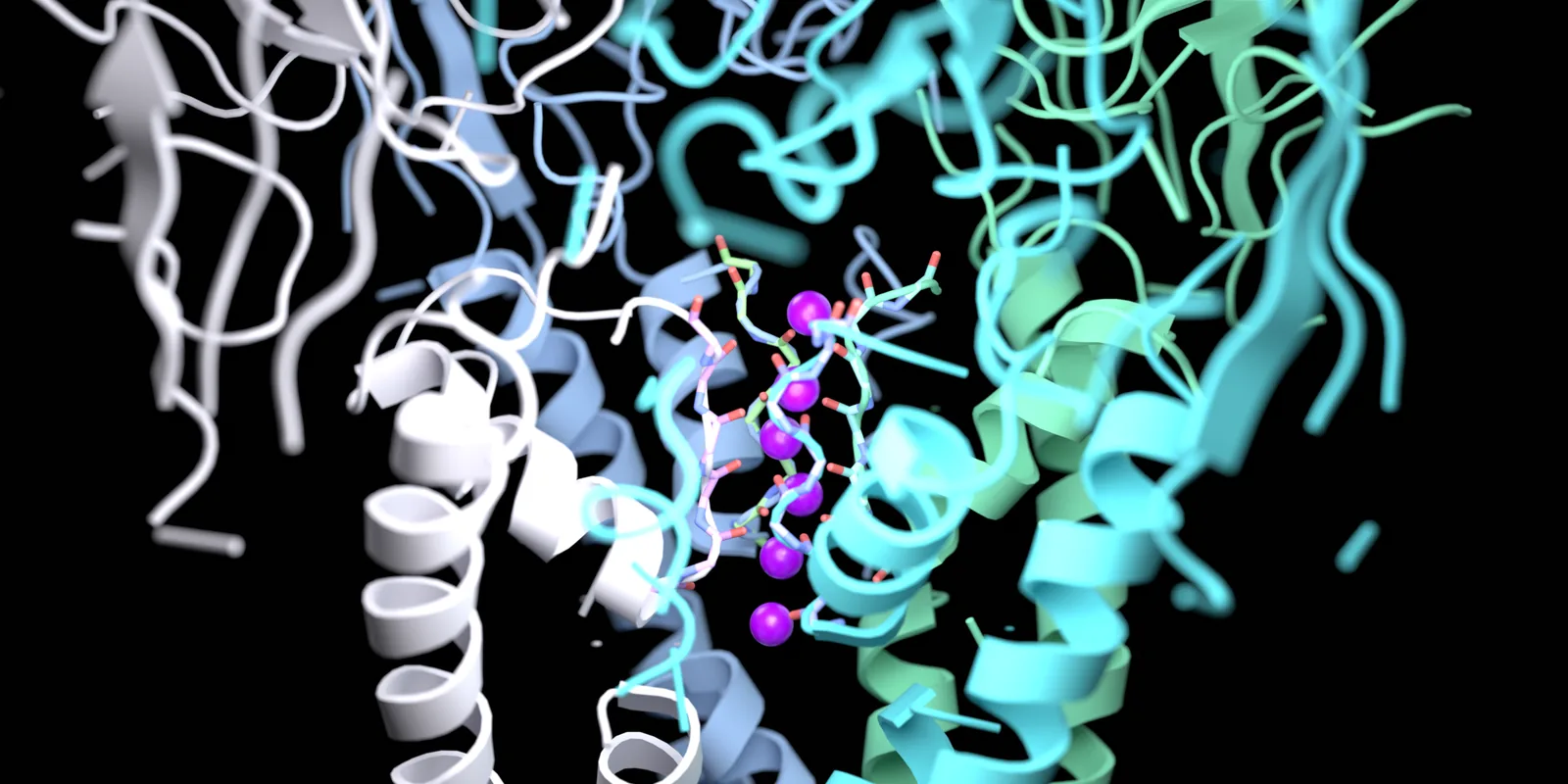
Metal ions sit at the heart of countless proteins, yet pinpointing exactly where they bind has stayed slow and unreliable. We built PRIME1, a deep-learning method that drops virtual “probes” onto a protein to find its metal-binding sites — accurately, and in about 11 seconds.
Why this matters
Roughly a third of all proteins need a metal ion to do their job. Zinc helps enzymes cut other molecules, iron carries oxygen in our blood, calcium relays signals inside our cells, and potassium flows through channels that keep our hearts beating. Whether you want to understand such a protein or redesign it as a new enzyme or drug, one basic question is surprisingly hard to answer: where, exactly, does the metal bind?
The difficulty is chemistry. Some metals are picky: zinc and copper grip a few specific amino acids, usually histidine or cysteine, leaving a clear fingerprint. Others are casual: calcium, sodium, and potassium bind loosely, almost anywhere the local chemistry is roughly right. (Chemists call the first group transition metals and the second non-transition metals.) Telling the true binding spots from the many places that merely look right is exactly where existing tools struggle.
What we did
We did not start with the method we ended up with. Our first attempt read only a protein’s sequence — its string of amino acids — using a protein language model called ESM2: a kind of AI trained on millions of sequences, much as a chatbot is trained on text. (Sequence-only metal-site predictors such as LMetalSite3 and M-Ionic4 take this same route.) For metals with plenty of data, zinc above all, it worked remarkably well. But the moment we turned to the metals biochemists really care about, like copper and iron, and to trickier cases such as ion channels, it fell short — and, reading only the sequence, it could never tell us where in 3D the metal actually sat.
That pointed clearly to structure. With AlphaFold5 now making 3D protein structures easy to obtain, a structure-aware predictor looked like the missing piece. Yet when we added structure, the gains were smaller than we hoped. The reason was scale: a protein is enormous next to a single ion, so searching it for one tiny binding spot is a needle-in-a-haystack problem — slow, and easy to get wrong. Existing structure-based tools, whether built on geometric rules (such as BioMetAll6) or on deep learning (such as Metal3D7, and its successor AllMetal3D8), all hit this same wall, especially for the many metals with little training data.
The way out came from an unexpected place: computer vision. Years ago, software faced the same “huge space, tiny target” problem when learning to spot objects in photos. A well-known family of methods (R-CNN9) cracked it with a two-stage trick — first quickly propose a short list of promising regions, then look hard at each one. We built the protein-chemistry version of that idea, and it gives our method its name: PRIME works by scattering virtual probes — tiny markers that each ask, “could a metal sit here?”
The trick is proposing that short list well, and here we lean on evolution. Over millions of years, evolution preserves the parts of a protein it cannot afford to change — including many of the spots that hold metals — and leaves a trace of them in the sequences we see today. The same protein language model from our first attempt reads this trace directly and cheaply, letting us shrink the search from a whole protein down to a few hundred candidate spots while still catching about 99% of the real ones. Around those candidates we then scatter the probes with a fast, GPU-friendly geometric step (a stripped-down version of an idea from BioMetAll), so this stage stays quick.
Finally, a second deep-learning model examines the 3D neighbourhood of each surviving probe and decides whether a metal truly belongs there. Propose, then examine — the same two-stage shape that worked for computer vision, now applied to metals.
The payoff is both accuracy and speed. Across 14 different metal ions, PRIME was more accurate than established structure-based methods — and finished in about 11 seconds per protein, where others can take minutes. That combination is what makes it practical to screen proteins by the thousand, rather than one at a time.
What it means, and what’s next
The most exciting part of a fast, accurate predictor is what it unlocks. Because PRIME runs in seconds and covers both the “picky” transition metals and the “casual” ones like calcium and potassium, it can be pointed at large protein collections — every protein in an organism, or the millions of structures now coming from tools like AlphaFold — to map metal chemistry on a scale that was impractical before.
PRIME is not the last word, though, and two limits are worth being honest about. First, it reasons about a static structure: it reads the protein exactly as it is given, so the prediction leans heavily on how accurate that input structure is. A small change near a binding site — or the shape shift a protein undergoes when a metal actually arrives, which an empty (apo) structure cannot show — can be enough to throw it off. Second, we still do not know how well it holds up on the very rarest metals. The rare-earth elements that matter so much in modern industry, for instance, are something we have not yet studied properly — and that is high on our list for future work.
Looking further ahead (and here I‘ll allow myself to speculate beyond what our data strictly prove): a reliable map of where metals bind is a stepping stone toward designing metal sites on purpose. That could mean engineering new metalloenzymes, finding drug targets that hijack a protein’s metal chemistry, or building screening pipelines that combine structure prediction with binding-site prediction end to end. Metals are everywhere in biology; the better we get at reading them, the more of that chemistry we can put to work.
References
-
Xu, S. & Onoda, A. Probe-Based Identification of Metal-Binding Sites Using Deep Learning Representations. Nat. Commun. 17, 8146 (2026). https://doi.org/10.1038/s41467-026-74657-x ↩
-
Lin, Z. et al. Evolutionary-scale prediction of atomic-level protein structure with a language model (ESM-2). Science 379, 1123–1130 (2023). https://doi.org/10.1126/science.ade2574 ↩
-
Yuan, Q. et al. Alignment-free metal ion-binding site prediction from protein sequence through pretrained language model and multi-task learning (LMetalSite). Brief. Bioinform. 23, bbac444 (2022). https://doi.org/10.1093/bib/bbac444 ↩
-
Shenoy, A., Kalakoti, Y., Sundar, D. & Elofsson, A. M-Ionic: prediction of metal-ion-binding sites from sequence using residue embeddings. Bioinformatics 40, btad782 (2024). https://doi.org/10.1093/bioinformatics/btad782 ↩
-
Jumper, J. et al. Highly accurate protein structure prediction with AlphaFold. Nature 596, 583–589 (2021). https://doi.org/10.1038/s41586-021-03819-2 ↩
-
Sánchez-Aparicio, J.-E. et al. BioMetAll: Identifying Metal-Binding Sites in Proteins from Backbone Preorganization. J. Chem. Inf. Model. 61, 311–323 (2021). https://doi.org/10.1021/acs.jcim.0c00827 ↩
-
Dürr, S. L., Levy, A. & Rothlisberger, U. Metal3D: a general deep learning framework for accurate metal ion location prediction in proteins. Nat. Commun. 14, 2713 (2023). https://doi.org/10.1038/s41467-023-37870-6 ↩
-
Dürr, S. L. & Rothlisberger, U. AllMetal3D: joint prediction of localization, identity and coordination geometry of common metal ions in proteins. bioRxiv (2025). https://doi.org/10.1101/2025.02.05.636627 ↩
-
Girshick, R., Donahue, J., Darrell, T. & Malik, J. Rich feature hierarchies for accurate object detection and semantic segmentation (R-CNN). Proc. IEEE CVPR 580–587 (2014). https://arxiv.org/abs/1311.2524 ↩
Comments